Léon Robinson
Journey to the End of the NightLéon Robinson is Ferdinand Bardamu’s fellow soldier and enduring war companion, a figure whose recurring efforts to get away from violence, work, and entanglement never secure him a lasting refuge. First met in the dark during the war, he openly seeks capture rather than combat; years later, he returns to Bardamu’s life carrying a history of flight, failed schemes, and fear of Madelon. Their last journey ends when Robinson refuses to go with her and she shoots him.
Identity and First Encounter
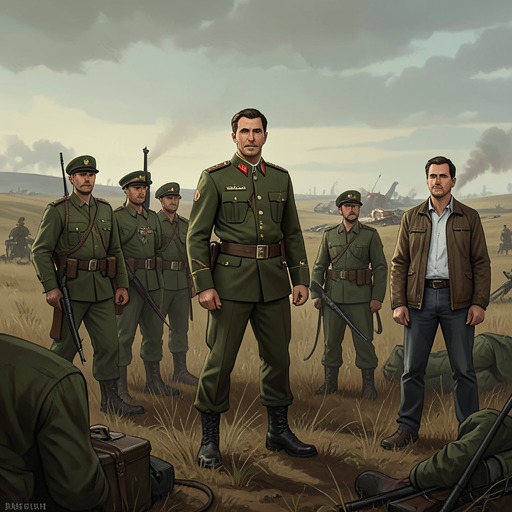
Robinson enters the novel at night, emerging from the grass near Bardamu. Bardamu has turned around after his horse tugs at its bridle and notices a change in the darkness. He calls out; Robinson answers in a hoarse voice and warns him not to shout. The scene initially presents him as a silhouette, a foot soldier with a cracked cap, and Bardamu approaches with his revolver in hand. In the confusion of the war, neither man is sure where the other belongs or whether he has seen the Germans they are looking for.
Robinson identifies himself as a reservist, the first Bardamu has met in the war. Bardamu hears a sadness in his voice that seems different from that of the Regular Army men, and this difference makes him trust Robinson a little. The cautious, partial trust matters: the two are strangers, but they recognize in one another a wish to escape the war rather than fulfill its demands.
Refusal of Combat and Attempted Escape
Robinson says plainly that he is fed up and intends to get himself captured by the Germans. His decision follows a disastrous confusion in which French sharpshooters, surprised by a company that arrived ahead of schedule, fired on their own men. Robinson knows the incident because he experienced it himself. The episode makes the distinction between the enemy and one’s own side feel precarious, while the war’s routine of danger leaves him seeking a way out rather than a cause to fight for.
He recounts finding his captain alone and gravely wounded, then passing him without stopping. Robinson had already decided to leave: he discarded his pack and weapon in a duck pond because he did not want to kill anyone and believed that carrying a weapon would make the Germans less likely to take him prisoner. His plan is practical and deliberately unheroic. Unarmed, he hopes, he will look like someone ready to surrender; he even imagines that complete nakedness would make it impossible to tell which army he belonged to.
Robinson describes himself as unsuited to fighting even in civilian life. He had worked as an engraver but disliked the arguments around the job. He preferred selling evening papers in a quiet neighborhood near the Bank of France, around Place des Victoires and Rue des Petits-Champs, where his territory extended no farther than Rue du Louvre and the Palais-Royal. He also ran errands for shopkeepers and took occasional delivery work. His war-time flight thus grows out of a preference for routine, limited work, and avoiding conflict—not from a newly discovered military strategy.
Bardamu’s War Companion
Bardamu and Robinson do not find a straightforward route to surrender. As they leave together, Robinson laments that Bardamu was not German and says that getting rid of oneself in a war is difficult. Bardamu jokes that a German captor might have earned Robinson a Médaille Militaire. Their exchange turns the language of military honor inside out: the medal appears as a possible reward for facilitating escape, while the men’s real wish is simply not to die.
They sit on a park bench and open a can of tuna Robinson has been warming in his pocket since morning. Gunfire is audible only far away, and they wish the combat would stay there and leave them alone. When they part, Robinson expects they might meet again; each goes back to his own war. The separation is not presented as a decisive break so much as an interval in a relationship that Bardamu later keeps alive through his repeated war stories. He introduces Robinson to Parapine as his war buddy and says that he has recounted their war and Africa stories many times, in many versions.
Return to Bardamu’s Life
Years later, Robinson appears on the road near the bridge at Vigny-sur-Seine, arriving from La Garenne. Bardamu recognizes him and initially resents the interruption, fearing that Robinson has come to disturb the comfortable routine he has been building. He asks whether Robinson is on the loose again, then invites him to eat. The familiar mixture of reluctance and hospitality shapes their renewed association: Bardamu is not glad to see him, but he cannot simply turn away his old companion.
Robinson says that he needs to make it appear that he is mentally unwell. Bardamu offers to help him find a small job, but Robinson rejects that solution; employment, even if available, would not meet the urgent need he describes. He wants to be taken for someone who has lost his reason. In the asylum setting, he explains that he hopes being confined among patients will protect him from Madelon, whom he expects to come looking for him. His plan turns the institution into a refuge and feigned madness into a means of evasion.
Robinson also recounts that he has tried again to kill Grandma Henrouille and insists that this second attempt was not bungled. He says that, as his eyesight improved, he could see her constantly and came to feel that she was poisoning his life. He points to the cramped house and its unstable cellar stairs as part of the circumstances surrounding the conflict. The disclosure extends Robinson’s pattern of escape into a more serious and destructive form: rather than endure the household situation, he attempts to remove the person he blames for it.
Madelon and the Ending
Robinson tells Bardamu that Madelon’s attachment became intolerable to him. He says that after she touched his scar and bump, she wanted to keep him close and protect him, even preventing her mother from berating him. Robinson says that he would have preferred to part as friends, but that the relationship could not continue. When Madelon and her mother went shopping, he packed a small bundle and left quietly. He fears that Madelon will find him and believes that confinement among the asylum’s patients would allow him to pretend not to understand her.
On the journey with Madelon, she demands that Robinson come with her and threatens to go to the police the next day, revealing what happened to Madame Henrouille on the stairs. Robinson replies that Madelon herself was involved and therefore cannot simply accuse him. She accepts the prospect that both of them might go to prison and continues to insist that he leave with her. Robinson finally answers that he will not come and tells her to do what she likes. Madelon shoots him in the taxi. Bardamu is beside Robinson as he collapses, and the driver stops beneath a gas lamp; Madelon pushes past the driver, gets out, and runs across the fields.
Robinson’s ending reverses the old war-time arrangement. Once, he and Bardamu had wanted the distant gunfire to leave them alone; now an intimate conflict has caught up with Robinson inside a moving taxi. His refusals—to fight, to take a weapon, to accept a job, and finally to go with Madelon—mark a persistent attempt to keep others from deciding his life. But evasion does not free him from the consequences of the violence and entanglements he has entered. In his final moments, after receiving morphine, he says that it is best to have it end this way and that the pain is less than he expected. He takes Bardamu and Parapine by the hands; Bardamu kisses him, and they wait with him until an internal hemorrhage kills him. Robinson’s death ends not only his flight but the long, uneasy companionship that Bardamu had preserved in memory and retelling.